
Industry
Rail & Transit
Connectivity for trains, buses and transit infrastructure, from trackside CCTV to depot video offload.
What the network needs to do
Transit operators need connectivity that keeps up with moving vehicles and reaches places where cabling is disruptive to install. Anywhere Networks supports both the rolling stock and the fixed infrastructure around it.
- Real-time CCTV from carriages, stations and track
- Passenger Wi-Fi and live journey information
- Condition monitoring and diagnostics
- Backup links supporting signalling and train control
- Video offload when buses return to the depot
Train-to-ground connectivity
Anywhere nodes on the train connect to a self-healing mesh along the track. Each mobile node has two radios: one stays connected to the current trackside node while the other joins the next, so handover is make-before-break and typically within 5 ms. Each train can carry up to 700 Mbps at 80 MHz for CCTV, passenger Wi-Fi and telemetry, and front and rear nodes together can provide 1 Gbps or more. No central controller is needed.
Stations, bridges and trackside
Fixed infrastructure needs video too, often where cabling would disrupt services. In Hong Kong, the MTR monitors shipping under the Tsing Lai Bridge over a dual-ring wireless mesh, and replaced analogue CCTV at the Yuen Long Light Rail terminus with a 9-hop wireless mesh across five platforms. In Saudi Arabia, a rail operator connects surveillance across 8 stations and more than 40 camera locations, with solar-powered nodes where power is unreliable.
Backup for train control
Safety-critical signalling usually runs on its own dedicated radio system, but a second, independent path adds resilience. In South Korea, a mainline operator piloted an Anywhere network along a 6.6 km section of line as a backup for its train control and signalling network.
Shuttles, monorails and people movers
Shorter systems follow the same design. An airport shuttle in South Korea carries passenger car video along a 3 km route between terminals, with trackside nodes roughly every 300 m. On the Danyang monorail, video from the cabins stays continuous across a 120 m climb.
Depots and video offload
Buses, trams and trains return to the depot with hours of recorded video. Fixed nodes around the yard connect each vehicle automatically on arrival, and many vehicles transfer at the same time, with traffic balanced across paths.
Built for rolling stock
The AX52e meets the rolling-stock standards EN 50121-3-2, EN 50155, EN 61373 and EN 45545-2, operates from -35°C to 65°C, and is the same node on the train and at the trackside.
Solutions for this industry
Train-to-Ground Wireless
High-throughput connectivity between moving trains and trackside networks, with handover typically within 5 ms.
Learn more →Wireless Video Offload
Move onboard video from fleet vehicles to central storage automatically, within a short depot stop.
Learn more →Video Surveillance Backhaul
Bring HD and 4K camera feeds back to the control room without trenching, across a self-healing wireless network.
Learn more →Customer stories

MTR Corporation · Hong Kong
Multi-hop virtual fibre for essential railway infrastructure
Wireless video surveillance for a railway bridge over a busy shipping channel and for a light rail terminus, both without new cabling.
Read the story →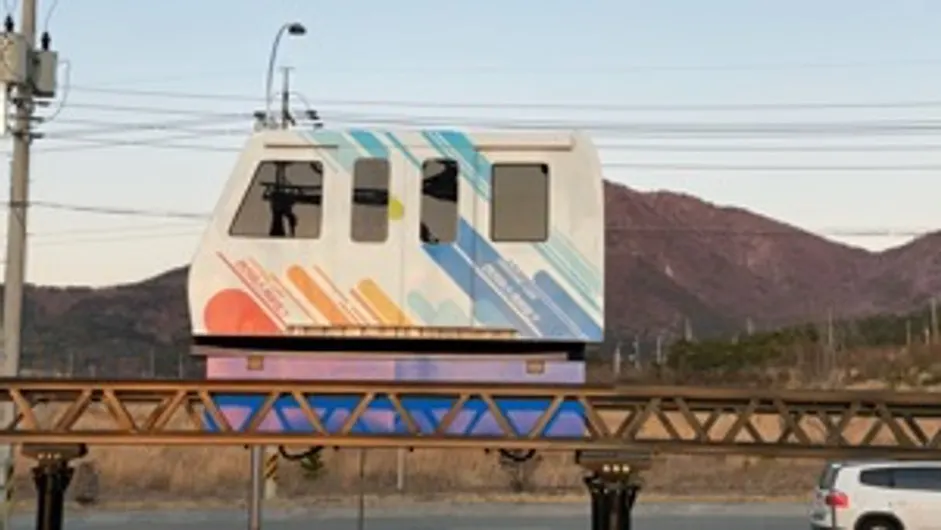
Danyang Monorail Project · Danyang, South Korea
Real-time video from moving monorail cabins
Stable IP camera video from cabins climbing a mountain monorail, without signal loss.
Read the story →Frequently asked questions
How fast is handover between trackside nodes?
Dual-radio make-before-break handover typically takes place within 5 ms, shorter than the gap between two frames of 25 fps video.
Does it replace our signalling radio?
No. Safety-critical signalling normally stays on its own certified system. An Anywhere network carries CCTV, passenger Wi-Fi and diagnostics, and can provide backup connectivity supporting signalling and train control.
Does it need licensed spectrum?
No. It uses unlicensed spectrum and operator-owned infrastructure, so there are no licence fees or per-gigabyte charges.
Can the same network serve depots?
Yes. Depot nodes offload recorded video from buses, trams and trains automatically as they arrive, alongside the train-to-ground network.
Further reading
Solution note
Connected Buses
Offloading video and fleet data as buses return to the depot.
Download PDF →Insight
Train-to-Ground Communication: Wi-Fi, LTE-R, 5G and Mesh Compared
Train-to-ground communication options for CCTV, passenger Wi-Fi and diagnostics compared: standard Wi-Fi, private LTE, public 4G and 5G, and wireless mesh.
Read →Insight
Offloading CCTV from Trains over a Wireless Mesh
How rail operators get onboard CCTV off the train: live viewing along the route, bulk offload at stations and depots, and how to size the wireless link.
Read →Insight
Seamless Handover for Moving Vehicles: What Under 5 ms Means for Video
Why conventional Wi-Fi roaming drops video on trains, vehicles and cranes, and how dual-radio, make-before-break handover keeps the link up on the move.
Read →Insight
How Bus Depots Offload CCTV Footage, and Why It Takes So Long
Why offloading onboard CCTV from buses at the depot is slow, what manual, cellular and Wi-Fi offload involve, and how a wireless mesh does it automatically.
Read →Talk to us about rail & transit connectivity
Our team can help you work out the right solution for your site.